




Did you know that the AGA has a long history of publishing about cats? Not just the beloved felines that have commandeered many homes and communities (not to mention ecologically devastating many areas…), but also their wild brethren. In fact, Darwin even mentioned cats in his Origin of Species, where he discussed the relationships between both blue eyes and deafness as well as calico coloration and sex. In the next few blog posts I am going to describe some of the work published about our feline friends in the Journal of Heredity. A reminder to all our members, you get free access to the articles mentioned from your membership homepage on the website!
A Reanalysis of the Problem of the Male Tortoiseshell Cat
Apparently we must revisit the question of male tortoiseshell (also known as calico) cats (which was a hot topic in the 1920s). The most common theories for the existence male calicos were:
- Male tortoiseshells resulted from chorionic vascular anastomosis (say that five times fast, AKA a shared placenta) much like the case of freemartin cattle where female twins were infertile due to the effect of male sex hormones during development. It was also thought at one point that male calicos must be genetic females or that there was a level of intersex happening in these cases. Anatomical studies reported in the 1930s had largely put this theory to rest as the male calicos possessed no vestigial female organs.
- Chromosomal abnormality, such as nondisjunction (hello XXY kitties)
Sprague and Stormont put forth an alternate hypothesis that male calicos resulted from a shared placenta on contrasting genetic backgrounds “resulting in a color pattern conditioned by cells of genetically different origins” in a kind of genetic chimera situation.
Turns out, male tortoiseshells can be attributed to both XXY and chimeras!
On the Origin of the Male Tortoiseshell Cat
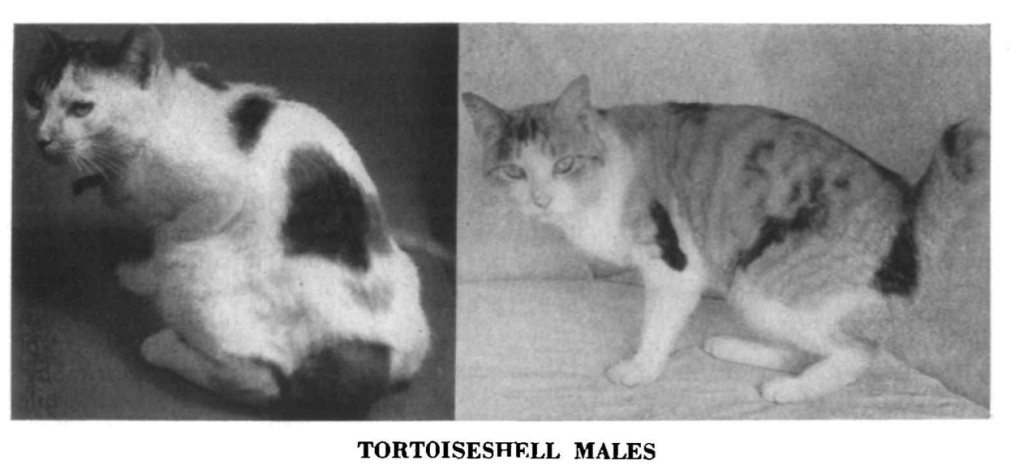 This article came to the JoH from the National Institute of Genetics in Japan, which 70 years later was also part of the team that found the deletion responsible for orange coloration in domestic cats. Pretty neat!
A survey of Japanese cats indicated that while orange has a sex-linked inheritance pattern, black and tabby were both autosomal. Interestingly, while a survey from the UK found a ~10% incidence of orange cats, the Japanese survey found a range of 25-40% (anecdotally, personal correspondence indicated a similar proportion of orange cats in Singapore). The inheritance of orange is dominant to black.
In Japanese culture, male calicos are considered lucky and were often reported in the local papers, leading to the authors identifying many examples. From observations, calico males are not generally fertile and are usually interested in tomcatting around once they reach sexual maturity, though there are exceptions. The males that do not act like normal tomcats have smaller testes with greatly reduced (or sometimes absent) germ and Sertoli cells in their tubules. However, the rare calico boys that do act like tomcats have normal testes.
The authors then hypothesize that the gene for orange must be transferred to the Y chromosome during a recombination event. At the time, one scientist maintained that cats had X and Y chromosomes of almost the same length, though quite a few others at the time had published karyotypes showing a smaller Y chromosome consistent with most other animals using XY sex determination. Komai and Ishihara postulated that there may be some gene complex responsible for fertility on the Y chromosome that is generally disrupted by the recombination event transferring the orange gene, but in rare cases the gene complex remains intact and thus fertile male calicos exist.
Mutant Stocks, Four Ears, and Yellow Siamese
Before it switched to mainly mice, the Jackson Memorial Laboratory of Bar Harbor, Maine, offered mutant cats and dogs to scientists. In 1957, they advertised two such feline mutants in the Journal of Heredity.
- A female with “a small extra pinna on each side, reduced eyes, and slightly undershot jaws” from Ohio was (in)bred to achieve a line of cats with the trait, thought to be a simple Mendelian recessive. Observations are as follows:
- The mutation is always bilateral and homozygous individuals are less active and more lethargic.
- The eyeballs may be greatly reduced and otherwise affected.
- The mutant appears to be genetically independent of color.
We know this kind of mutation as auricular polyotia, although the actual genetic cause is unknown. It is largely thought to result from neural crest cells getting freaky during development (abnormal migration).
- The yellow Siamese (which I think is actually an orange Siamese) stock were homozygous orange cats with acromelanism.
Things were not as exciting this week but should pick back up when we enter the 1960s! We have our first instance of big cat genetics as well as the beginning of the delightful adventures of Neil Todd traveling lots of places in the name of domestic cat population genetics.
About the Author
Miranda Wade received her B.S. in Biological Science from Colorado State University and her dual PhD in Integrative Biology and Ecology, Evolutionary Biology, and Behavior from Michigan State University. During her time in the Meek Lab at MSU, her work consisted of using ‘omics to address various conservation questions about land-use change and microplastics exposure. She is currently the Social Media Editor for the American Genetic Association and a PostDoc in the Sin Lab at the University of Hong Kong. For her postdoctoral work, she is exploring the genomic basis of coloration in birds. She is the proud owner/caretaker of three cats.