




Did you know that the AGA has a long history of publishing about cats? Not just the beloved felines that have commandeered many homes and communities (not to mention ecologically devastating many areas…), but also their wild brethren. In fact, Darwin even mentioned cats in his Origin of Species, where he discussed the relationships between both blue eyes and deafness as well as calico coloration and sex. In the next few blog posts I am going to describe some of the work published about our feline friends in the Journal of Heredity. A reminder to all our members, you get free access to the articles mentioned from your membership homepage on the website!
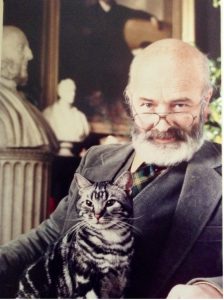
This week we begin what I am considering the JoH takeover by Neil Todd. Who is Neil Todd, you might ask? To quote Carlos Driscoll, current AGA Manager and Journal of Heredity Managing Editor:
Todd was an amazing guy, he was right about so many things that he didn’t derive from genetics; he just made intuitive-, natural history-, biology-based- inferences. My entire doctoral thesis was essentially saying he was right, I just did it with DNA.
Todd published his honors thesis in the Journal of Heredity in 1961, which I discuss below. His doctoral dissertation was about the response cats have to catnip. His postdoctoral work was on lions in the Gir Forest, Gujarat State, India. He traveled to places like in Canada, Great Britain, Ireland, Iceland, the Faroe Islands, France, Spain, Iran, Morocco, Tunisia, Greece, Turkey, Egypt, Sudan, Mexico, Curacao, and Venezuela to track genetic markers such as coat patterns in cats related to shipping and trade markets. He took probably the best portrait I have seen (on the left) where he is just aura farming for DAYS. The twinkle in his eye, the glasses slid far down his nose, the absolutely contented look of the cat on his lap. WHAT A LEGEND.
Neil Todd died in 2014.
A Pink-Eyed Dilution in the Cat
Ah, the first work by Neil Todd in the Journal. In 1958, a kitten with mostly pink eyes, a diluted coat, and potentially impaired vision (from behavioral observations) was born in a litter of otherwise-normal kittens. She later had a litter of her own that consisted of all wild-type kittens. Todd thought the mutation was likely to be autosomal recessive.
Oculocutaneous albinism is a group of autosomal recessive disorders (honestly, I could write a blog just about these since there are quite a few) where melanin is reduced or in some cases absent from the skin/hair/eyes and vision is affected. In cats specifically, a 2020 paper described a mutation in HPS5 in the Donskoy (a breed of naked cat) leading to the pink-eyed dilution.
It is hard to say if the same mutation existed in the cat described by Todd, or if another mutation that has not been described in cats created the unique coloration. Maybe we will know more in a few years!
The Inheritance of Taillessness in Manx Cats
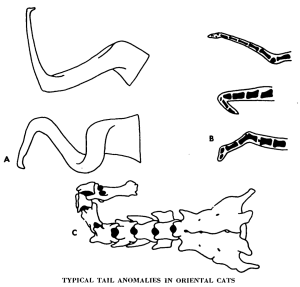 Here is the Undergraduate Honors Thesis from Neil Todd I mentioned earlier. There is also a delightful footnote in the article which reads: “The author wishes to thank the Calo Pet Food Company for their generous supplies of Calo Cat and Dog Food and Lowe’s, Inc., for an unlimited supply of ‘Kitty Litter.'”
Cats on the Isle of Man (located in the Irish Sea between England and Ireland) have been famous for well over a century and a half for their shortened, or in some cases missing, tails. Todd attempted to deduce the genetic underpinnings of this anomaly by conducting a literature review, interviewing owners of Manx cats, and undertaking a limited breeding program.
Through the breeding program, Todd determined that the “Manx gene” was inherited in an autosomal dominant manner. However, he also found that “breeders over a period of 50 years have failed to produce a “pure” strain of Manx cats. This immediately suggests a lethal function (pleiotropy) or factor (autosomal linkage).”
He also found it interesting that there are populations of tailless cats in Asia (the so-called “Oriental cats”), and suggested that the Manx gene may have an Asiatic origin. We now know that a number of different mutations can affect the T locus in cats (and mice) and contribute to taillessness in multiple populations/breeds.
A minor correction was published later in 1961.
Inheritance of the Catnip Response in Domestic Cats
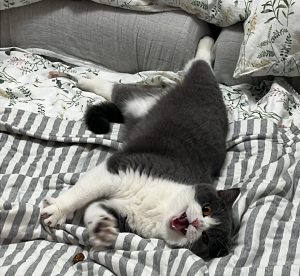
I think most of us, even those without access to cats, are familiar with the common response of cats to catnip (Nepeta cataria; also thank you, Internet). A terpene from the plant, called Nepetalactone, creates a sense of euphoria in cats. When they’ve encountered the plant, cats generally sniff, lick, rub, and roll around in it totally blissed-out. More recent work using silver vine (Actinidia polygama; which produces a similar compound to that in catnip called nepetalactol) shows that exposure to the compound releases endorphins and activates pathways similar to opiates like heroin. However, the rubbing on and rolling in the plant also confers an unexpected benefit: mosquito repellence! (See this quick write-up and video for further detail).
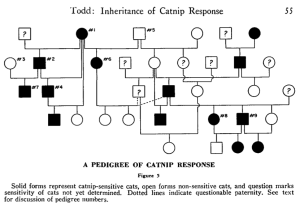 Very young kittens (those under 6-8 weeks of age) tend to exhibit no or even an avoidant response to catnip, and there are also some adults out there that are completely indifferent to the herb. These observations got Todd wondering if there was some sort of genetic underpinning to the preference (or not!) for catnip. Todd turned yet again to a cat colony (but not the Manx one mentioned above), but this time had stud cats from a Siamese breeder with some outside animals (although there was still an icky amount of inbreeding, see the pedigree on the right. Side note: this is why you should sterilize your pets!!!!!). The colony was exposed to catnip and their responses recorded. In two separate cases a pairing of ‘responders’ resulted in non-responding offspring (1×4 & 8×9), which makes catnip response seem like a dominant trait. Sex-linked dominance was excluded by the results of cross 2×3, whereby an unresponsive female gave birth to a responsive male.
The degree of response was also assessed based on if the cat performed all four responses: sniffing/licking/head & chin rubbing/body rolling. Todd found no correlation between the genotype (if the cat was thought to be heterozygous) and the number of behaviors exhibited. Nowadays, the catnip response is generally considered a dominant trait amongst cats!
About the Author
Miranda Wade received her B.S. in Biological Science from Colorado State University and her dual PhD in Integrative Biology and Ecology, Evolutionary Biology, and Behavior from Michigan State University. During her time in the Meek Lab at MSU, her work consisted of using ‘omics to address various conservation questions about land-use change and microplastics exposure. She is currently the Social Media Editor for the American Genetic Association and a PostDoc in the Sin Lab at the University of Hong Kong. For her postdoctoral work, she is exploring the genomic basis of coloration in birds. She is the proud owner/caretaker of three cats.