



About the Author
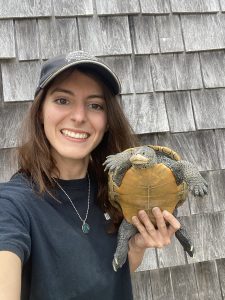
Amanda Lyons is broadly interested in how animals interact with each other and their environments, with a particular focus on how reptiles, amphibians, and birds move, disperse, and experience different habitat types. Her work has investigated population genetics and spatial ecology of turtles, while projects she’s supervised include studies on avian behavior and species diversity at restoration sites. She enjoys work that combines field and lab components to examine ecological questions from multiple angles. She also enjoys learning new software, coding, and creating beautiful and informative maps using ArcGIS products. When not knee deep in salt marsh mud with a turtle in hand or teaching interns how to manipulate data in R, She is often hiking, birdwatching, or working on her latest creative project. Her passions include writing poetry and fantasy novels, studying languages and world religions, and practicing Okinawan and Japanese martial arts, which she’s studied for more than 20 years.
A Turtle Path: The Long Scramble from Conceptualization to Publication
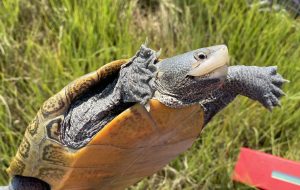
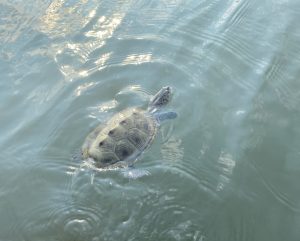
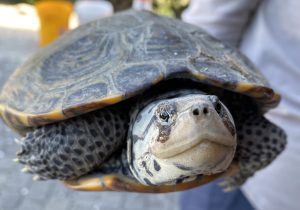
Turtles are often categorically thought of as slow, and watching a diamondback terrapin plod across a crosswalk might seem to confirm this. However, over my many years studying these semi-aquatic turtles, I learned that while they might move at their own pace when they are not under pressure, try to pick one up and you will be met with surprising bursts of speed and agility. With this in mind, I have often written that turtles are not slow, they are patient, with their energies stored for the right place and time. In the turtle spirit, I thought it might be helpful for other early career scientists to read how a series of right place, right-time serendipitous events, hard plodding work and perseverance through life’s peaks and troughs resulted in the publication of the terrapin population genetics study this fall, what seems like a lifetime after we first conceptualized the project.
In October of 2017, during parents’ weekend at Brown University, I found myself at Harry’s Bar & Burger on North Main Street in Providence, Rhode Island because my father wanted a hamburger. This dining choice, unlikely given my own careful health-conscious diet, started my research career.
At the next table over, University of Rhode Island biologist Dr. Laura Meyerson was having a conversation about invasive phragmites in salt marshes. During a lull in her talk, she noticed that I was a Brown student and asked me about my studies. Many years earlier, I had written my eighth grade research paper about phragmites, so naturally I had a lot of questions and our conversation turned back toward marshes. She asked me how I felt about turtles. I happened to be one of twenty students currently taking Professor Don Jackson’s turtle physiology seminar, gift of Brown’s Open Curriculum. She invited me to visit a relatively isolated field site where she strongly felt someone ought to research diamondback terrapin genetics and cc’d me on an email to Dr. Tyler Kartzinel at Brown who ran a genetics lab equipped for the task.
I joined Tyler’s lab in December of 2017 and set to learning what I could about terrapins while we and collaborators worked through the process of acquiring funding and permits. In the winter break that followed, I applied for a research internship at The Wetlands Institute, conveniently located just a few towns away from my parents’ summer home in New Jersey, where a diamondback terrapin research program had been ongoing for many years. Summer of 2018 brought me to the Institute to gain valuable hands-on experience working with the turtles that I would soon be researching in the genetics lab. With Tyler’s enthusiasm, I asked the research team at the Institute if I could collect DNA samples from their study populations the next summer, initially thinking that the New Jersey samples would serve as a good out-group for any analyses we performed on our Rhode Island populations.
Other key collaborators, then-PhD student Bianca Brown and then-Rhode Island state herpetologist Scott Buchanan, had bigger and better ideas. As news about the genetics project spread, Bianca and Scott’s connections offered samples from sites throughout Massachusetts, Connecticut, and New York. When we started sample collection in 2019, it was for a regional analysis considering populations from every state in the northeastern part of the terrapin’s range.
That autumn, we hit the ground running with lab work. In the winter, I shadowed Dr. Rebecca Kartzinel, our RADseq expert, while we prepared the first libraries for sequencing. Data from this first round of sequencing came in with enough of the spring semester left to pull together some quick summary statistics, make broad generalizations about the relationship between genetic diversity and latitude, and write up a senior thesis. However, we did not have enough time to look at population connectivity, which had become a core goal of the project.
To graduate and walk away at this point felt like giving up. With some challenges, I applied for a fifthyear Master’s, resurrecting a departmental program which was still technically on Brown’s website but had not been dusted off for more than ten years. Adding to the uncertainty of the program, the COVID-19 crisis sent me home for the last few months of my undergraduate career, and when fall came, I moved back into an eerie ghost-town version of Providence, with online classes, online lab meetings, and lab work conducted in a building by myself. I was ready to launch straight into DNA extractions, but the two-week mandatory quarantine for returning students slowed me down. Likewise, the semester was shortened such that everyone was sent home for winter break before Thanksgiving. I finished genomic library prep, this time necessarily conducted alone with Tyler and Becky ready to pick up the phone to answer questions, on the last day before my parents picked me up to take me back south, an unfortunate requirement because it was deemed unsafe to take the train. When we got news from the Brown Genomics Core that our library quality was too low and we should do an additional bead clean, there was no one around to do it until spring.
When spring did come and campus opened back up, the quarantine rules meant that I had to wait another two weeks to do the bead clean and resubmit the libraries. We finally received data in March of 2021, approximately six weeks before my Master’s thesis deadline. Highly caffeinated and routinely working until 4a.m., I was finally able to look into population connectivity, performing AMOVAs, looking at Fst values, generating resistance distances that restricted turtle movements to the water and running Mantel tests to foray into landscape genetics. There was more I wanted to do, but time was up. Within one week I faced my thesis defense and two online conference talks, then packed up and shipped off back to New Jersey.
I started a research assistantship at The Wetlands Institute two weeks after graduation. It was posted as a five-month intensive position, and when I finished, I was going to dive deep into admixture analyses, try all of our workflows again with a rarefied dataset to account for populations with small sample sizes, and get the paper published before looking for another job. One research assistantship became a second, then a salaried position. Working nights and weekends on the genetics paper (around busy field seasons, family obligations, bereavement, relocation, and so much more), we tried two, then three different approaches for rarefaction. We found that we had too much missing data in the original analysis and changed our filtering workflow. We added the admixture analysis, which emphasized some of our most exciting results. We ran additional AMOVAs, learned some good things from them and decided they were covered well enough elsewhere. We rewrote the manuscript, and rewrote it again, and rewrote it again. Finally, in autumn of 2024, I left my job at The Wetlands Institute, intending to fulfill lifelong dreams of traveling Japan and publishing my sword-and-sorcery novels. But first, I needed to run the genetics project analyses one more time, update all the numbers in the manuscript, remake the figures, and streamline the discussion.
In May of 2025 we submitted the paper, and in September, nearly eight years from that first fateful meeting in Harry’s burger bar, I got the news in the airport on the way to Japan that it was accepted to the Journal of Heredity. Looking back at the long and circuitous arc of the project, it feels shocking to recognize all of the time that has gone by. Still, regarding all of the challenges and small victories and the personal development that it took to face each obstacle without giving up, I remember that turtles are not slow, they are patient and brilliantly agile, and it all seems right on time for turtles’ pace.
References:
Lyons, A. L., R. Y. Kartzinel, B. R. P. Brown, S. W. Buchanan, L. M. Ferguson, B. A. Williamson, and T. R. Kartzinel. 2026. Levels and partitioning of genetic variation of northeastern populations of diamondback terrapin (Malaclemys terrapin). Journal of Heredity 117(1): 73-84. https://doi.org/10.1093/ jhered/esaf066