




Did you know that the AGA has a long history of publishing about cats? Not just the beloved felines that have commandeered many homes and communities (not to mention ecologically devastating many areas…), but also their wild brethren. In fact, Darwin even mentioned cats in his Origin of Species, where he discussed the relationships between both blue eyes and deafness as well as calico coloration and sex. In the next few blog posts, I am going to describe some of the work published about our feline friends in the Journal of Heredity. A reminder to all our members, you get free access to the articles mentioned from your membership homepage on the website!
This week we have our first instance of big cat genetics!
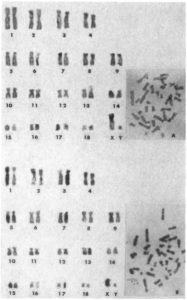 Chromosomes of the lion
By the early 1960s scientists had already determined that the domestic cat and Bengal tiger had 38 chromosomes. It seems that the author, Brunetto Chiarelli, got his start in karyotyping humans and other primates. These findings are consistent with previous reports from Makino and Tateishi.
While there is not much more to say about this paper, I will say I am impressed to find that it looks like Chiarelli was publishing all the way into to 2010s!
Phenotypic variability of taillessness in Manx cats
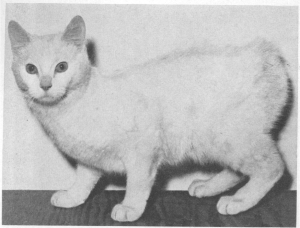 The degrees of taillessness are named as follows:
- “Rumpy” cats have no coccygeal vertebrae (such as the cat on the right)
- “Rumpy-riser” cats have several vertebrae, but fixed in an upward position in such a way that cats can only move their tails long a vertical plane
- “Stumpy” cats which have several vertebrae which are abnormal and results in a severe kink, but these cats can move their tails both horizontally and vertically
- (There is now apparently a variant called “longy,” which have a nearly-normal length tail)
Through test crosses, Howell and Siegel found that rumpy X rumpy crosses had the smallest litter sizes, and that crossing any tailless cat with a “Domestic normal” resulted in the largest overall litter sizes.
Just a reminder, taillessness is an autosomal dominant trait that is lethal in its homozygous form. Cats with extreme taillessness (such as the “rumpy”) can have severe congenital defects that lead to incontinence and neurological and locomotor issues. While “rumpy” cats may be cute, it is perhaps arguable that humans should not be selecting for this phenotype.
Independent assortment of Manx and three coat color mutants in the domestic cat
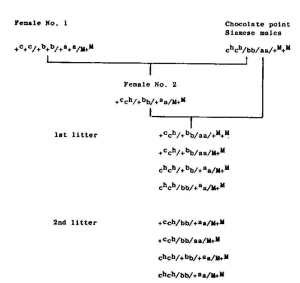 Here we have Neil Todd again showing us the merits of good ol’ pedigree genetics (I am so glad we no longer have to manually typeset though; this looks like it was not fun to do). Through crossing a Manx female and then her daughter, to chocolate point Siamese males (although Todd says they are not the same individual thankfully…).
The idea here is that if Manx was linked to any of the other wild-type alleles, the two traits could not co-occur without recombination in the offspring of the daughter Manx.
However, the wild-type colors all co-occurred with the taillessness in the second generation, suggesting the color genes and taillessness are not linked and thus comply with Mendel’s Law of Independent Assortment.
The independent assortment of dominant white and polydactyly in the cat
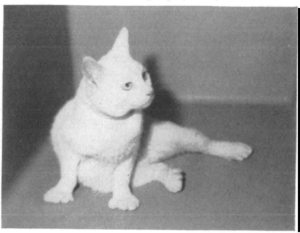 Neil Todd strikes again! Like his work described above, Todd reports on a cross of a dominant white female and pigmented male who were both presumedly carriers of polydactyly (which is a dominant trait). Their litter consisted of a combination of pigmented/white offspring with some kittens also having an abnormal number of toes.
A dominant white polydactyl female and dominant white normal-toed male from the litter were bred together (ew for the inbreeding of it all, even though this is how ‘true-breeding’ strains in genetics were created) FIVE times. They produced various combinations of pigments/toes.
Todd then discussed coupling/cis versus repulsion/trans arrangements of linked genes. I thought this might be useful to illustrate (see below). I have the genes denoted as Ww for the dominant white and Pp for the polydactyly. For clarity, I have the dominant allele both capitalized and bolded. In cis linked genes, the wild-type alleles are on one homologous chromosome, and the mutant alleles are on the other (the middle option). In a trans configuration, One wild-type allele and one mutant allele are on the one chromosome, and the opposite configuration is on the other (the bottom configuration).
The idea here is that, in the case of linked genes, if the heterozygous parent (in this case, the white tailless female on the left; no I don’t know why she has glasses) is in the cis arrangement where the two dominant forms of the gene on the same homologous chromosome (the middle scenario), the offspring will be disproportionately representative of the WP phenotype since a parental-type chromosome is more commonly inherited (aka no crossing over/recombination). If the linked genes are in a trans configuration (bottom scenario), the Wp phenotype will more likely be represented in the offspring. For the trans arrangement, any pigmented, normal-toed kittens would only be possible if there was a recombination event!
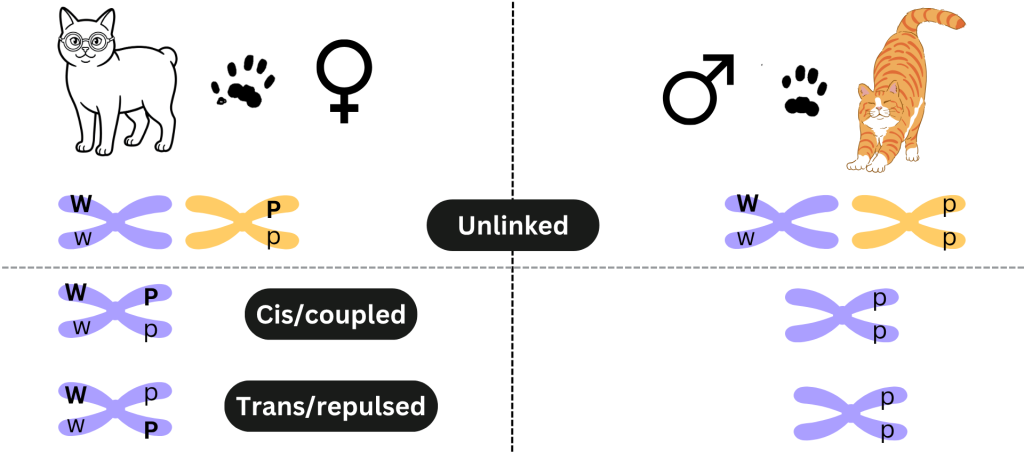
From his kitten phenotype data, Todd concluded that there was no repulsed linkage due to the high incidence of pigmented, normal-toed kittens. He then performed another test cross (using the male pictured above, who was presumed heterozygous for both genes) and calculated the proportions expected under non-linkage or coupled arrangements. He concluded with his data that, barring a recombination rate of at least 25% in the case of coupled genes, the dominant white and polydactyl gene are unlinked and inherited independently.
About the Author
Miranda Wade received her B.S. in Biological Science from Colorado State University and her dual PhD in Integrative Biology and Ecology, Evolution, and Behavior from Michigan State University. During her time in the Meek Lab at MSU, her work consisted of using ‘omics to address various conservation questions about land-use change and microplastics exposure. She is currently the Social Media Editor for the American Genetic Association and a PostDoc in the Sin Lab at the University of Hong Kong. For her postdoctoral work, she is exploring the genomic basis of coloration in birds. She is the proud owner/caretaker of three cats.