




Did you know that the AGA has a long history of publishing about cats? Not just the beloved felines that have commandeered many homes and communities (not to mention ecologically devastating many areas…), but also their wild brethren. In fact, Darwin even mentioned cats in his Origin of Species, where he discussed the relationships between both blue eyes and deafness as well as calico coloration and sex. In the next few blog posts I am going to describe some of the work published about our feline friends in the Journal of Heredity. A reminder to all our members, you get free access to the articles mentioned from your membership homepage on the website!
Morphological Effects of the Manx Factor in Cats
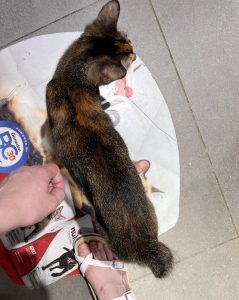
We return to the lovely Manx cat with an investigation into whether or not the degree of taillessness corresponds with variation in the number and/or length of the vertebrae of the entire spinal column. To determine this, the authors radiographed a lot of Manx cats.
For clarity, cats with no coccygeal vertebrae are called “rumpy”, cats with several coccygeal vertebrae in an upright position are deemed “rumpy-risers”, those with several coccygeal vertebrae which may have a severe kink resulting from abnormal vertebrae are called “stumpy”, and those with normal tails “longie”.
Their findings included:
- None of the Manx or control cats lacked any cervical or thoracic vertebrae, however some of the Manx were missing a single lumbar vertebrae.
- The “longie” Manx cats had no significant difference in the number of coccygeal vertebrae compared to the controls.
- The average length of vertebrae was overall longer in male cats compared to females. It is not clear if this data was corrected in any way for body size or weight.
- The vertebrae were generally shorter in Manx cats compared to the controls. This was especially significant for the lumbar vertebrae.
- Many Manx had abnormal spinal fusions.
Collectively, these results indicate that the influence of the Manx factor on the reduction, length difference, and fusion of vertebrae is restricted largely to the posterior portion of the spinal column.
Gene Frequencies in the Cat Population of New York City
We have our first instance of cat population genetics in the Journal! This is also the first of Neil Todd’s travels around the world for cat population genetics specifically. Briefly, Todd blitzed his way through several animal rescues and recorded phenotypes. He focused on the loci for sex-linked black & red; and the autosomal factors full, silver, Siamese pigmentation; Abyssinian, striped, blotched tabby ; non-dilute, blue dilution; short, long hair; normal toes, polydactyl; and pigmented, dominant white. These loci were based on those published by the self-taught geneticist Roy Robinson. We have also discussed most of these in earlier blog posts!
Todd found the population in NYC to be in Hardy-Weinberg equilibrium. He recorded no polydactyl cats, but a couple of Manx littermates and a syndactyl (where some digits are fused or webbed) cat. He also compared his estimated allele frequencies to previous work in London, England, Boston, Massachusetts, and Rochester, New York. He largely found very similar frequencies in the USA cats, which led to his conclusion that “Cats of the northeastern United States appear to belong to a single, stable and distinct gene pool.”
Gene Frequencies in the Cat Population of Paris
Right on the heels of our first published article explicitly about population genetics of cats comes another, this time exploring gene frequencies in Paris, France based on cats euthanized at an animal control facility. At the time, reports had been published from London (UK), Mishima (Japan), Singapore, and a few East/West Coast cities in the US. This work also includes some of the first attempts to classify the amount white spotting present on domestic cats (I think the first instance was by Searle in his cataloging of London cats). All in all, PH Dreux recorded almost 1200 cats. Similar to the gene frequencies calculated by Todd, Paris’s cats appeared to be in Hardy-Weinberg Equilibrium.
Interestingly, Dreux made the case for humans enacting artificial selection on the cats due to an overabundance of orange males and a paucity of tortoiseshells. However, his data did not really back this up. Dreux had more to say about gene frequencies in French cats!
Gene Frequencies in the Cat Population of a French Rural District
The difference in how science treats study animals today compared to the 1960s (and, of course, earlier) is quite striking. In this work, Dreux assessed cats that were used in “Parisian neurophysiology laboratories” but sourced from rural France (Mayenne). These cats were obtained from a “dealer” who trapped/otherwise obtained cats from farms. Dreux ultimately agreed with Searle and Todd that there was quite a bit of homogeneity in domestic cats. However, Dreux also started to develop the idea that urban environments favor darker colored cats compared to rural environments. Probably the most famous (and literally a textbook example) incidence of urbanization (or, more accurately, increased pollution from industrialization) leading to color change was found in Kettlewell’s famous work on the peppered moth (although see this more recent work that expilicitly discusses the genetics). However, and somewhat contrastingly, more recent work has found that, in birds, successful urbanization is associated with brighter plumage.
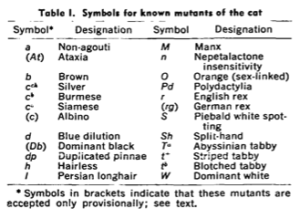 The PDF for this paper also comes with a bonus “Standardized Genetic Nomenclature for the Domestic Cat” wherein a Committee established that cat genetic nomenclature should follow that of mice. They also predicted that there would eventually be an established inbred line of cats for genetic study (as far as I know that never happened).
Cat Gene Frequencies in Two Australian Cities
Now we are making our way Down Under (gah, I’m sorry if anyone reading this is Australian, I am just a cringey American who thinks I am funnier than I actually am). ANYWAYS
Moffatt reports gene frequencies from Melbourne and Brisbane. There were much lower sample sizes reported (though let’s be real, domestic cats did and do a number on native Australian wildlife, they are known to absolutely destroy small animals wherever they are allowed to roam). Moffatt also found that the gene frequencies did not follow expectations under random mating (AKA they were not in Hardy-Weinberg Equilibrium) and the sex ratio was skewed.
Cat Gene Frequencies in Chicago and Other Populations of the United States
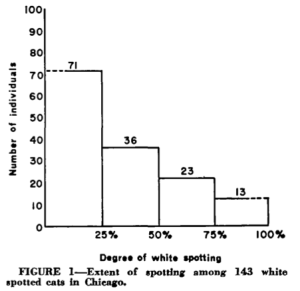 To round out the 1960s we have another report by Neil Todd. This time he was in an animal control center in Chicago counting and cataloging felines. What I find especially fun about this article is that instead of just reporting in tables, as pretty much everyone else had done up until this point, he has GRAPHS! Yay technology! In all seriousness, up until around this point scientific articles were mostly tables, photos, or hand-drawn graphs. The addition of computer-generated plotters the 1960s revolutionized how we presented science.
At this point, it was thought that the origin of domestic cats in the US was Northwest Europe in 17th century. From this origin, the cats were then subjected to the “urban factor” favoring darker coats in urban areas and lighter coats in rural ones. Todd postulates that Orange (O, sex-linked dominant) increases in frequency from the northeast to the southwest, related to the “urban factor.” He found no such geographic cline in non-agouti (a, autosomal recessive) but that there were higher frequencies in denser cities such as Chicago, New York City, and Philadelphia. Neither blotched tabby (t^b, autosomal recessive) or dilute (d, autosomal recessive) showed obvious patterns.
The last thing I will leave you with is this awesome term that Todd came up with: the “‘coefficient of darkness’ which is the frequency of the two darkest phenotypes for males.” This never caught on in the world of cat genetics, but I am a stan for overly dramatic phrasing!!
About the Author
Miranda Wade received her B.S. in Biological Science from Colorado State University and her dual PhD in Integrative Biology and Ecology, Evolutionary Biology, and Behavior from Michigan State University. During her time in the Meek Lab at MSU, her work consisted of using ‘omics to address various conservation questions about land-use change and microplastics exposure. She is currently the Social Media Editor for the American Genetic Association and a PostDoc in the Sin Lab at the University of Hong Kong. For her postdoctoral work, she is exploring the genomic basis of coloration in things that fly. She is the proud owner/caretaker of three cats.