



By Joe Lopez for the GIGA VI Organizing Committee
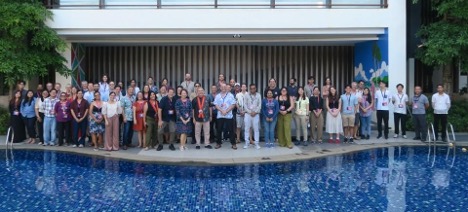 In spite of war time fuel price hikes affecting the much of the world, long travel distances and imminent monsoon season, close to 70 researchers from at least 14 different countries converged on the small scenic island of Boracay to discuss the latest advances in genomic science that would impact aquatic marine invertebrate biology (https://gigavi.org/). To arrive at the GIGA VI Savoy Hotel Boracay conference site, participants used various modes of transportation – plane, ferry over short waterways, and car, van or jeepney across islands large and small. The GIGA VI conference commenced with special introductory addresses from Dr. Clement Camposano, Chancellor of the University of the Philippines (UP), Visayas, and Philippine Ambassador to Belgium, H.E. Jaime Victor Ledda.
Although a category 5 typhoon (Bavi) had formed in the Pacific and was slowly approaching Philippines waters on the weekend before the meeting, she eventually veered north, and the GIGA VI conference was able to proceed according to plan for five days, July 6-10 2026 at the tropical locale.
The majority of participants hailed from the host country, the Philippines, which helped showcase local advances and challenges and which coincidentally overlaps the Coral Triangle, center of coral reef biodiversity.
Professor Jean-François Flot from the Université libre de Bruxelles (ULB), Belgium organized the main GIGA VI scientific program, as he is a frequent visiting scientist in the Philippines. Dr. Flot worked with Dr. Cynthia Saloma, Dean of the College of Science, UP Diliman and Dr. Victor Marco Emmanuel N. Ferriols, Professor and Director College of Fisheries and Ocean Sciences – Institute of Aquaculture, UP, Visayas, who was instrumental in coordinating the local scientific team from the Philippine Genomics Center (PGC). The rest of the invaluable organizing committee are listed here – https://gigavi.org/event-organizers/ . Dr Flot also led a mid-week, hands on workshop on the latest genome assembly methods.
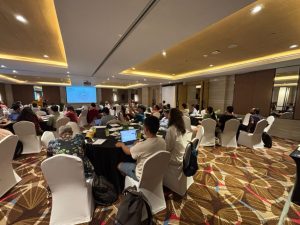
GIGA VI presentations included 7 keynote lectures among 35 regular talks, 5 speed talks and 7 posters. Engaging session topics encompassed Philippine biodiversity, the genomics of marine symbiosis, lesser known taxa and molluscs, current genomics methods and analyses, whole genome sequencing aspirations and the latest studies in conservation and population genomics.
The seven keynote speakers delved into various relevant topics: “reference genomes for informed conservation action in the Philippines” (Carmen “Menchie” Ablan, De La Salle University Philippines), “ molecular evolution of algal symbiosis in corals and giant clams (Chuya Shinzato, University of Tokyo, Japan), “molecular innovation and adaptation within invertebrate genomes” (Agostinho Antunes, University of Porto, Portugal), “predictive genomics for climate-resilient conservation” (Manuel Aranda, King Abdullah University of Science and Technology, Saudi Arabia), “data mobilization of genomics and biodiversity through innovative publishing models such as GigaScience” (Scott Edmunds), “reference genomes in the Sanger Institute Tree of Life Programme” (Caroline Howard) and “an atlas of mulluscan genomics” (Marcela Uliano-Silva). Dr. Ablan started the conference by showcasing the ease or difficulty of carrying out biological collections to sample the enormous biodiversity in the Philippines, and the official permitting required. Fueled by regular infusions of Filipino snacks, meals (magsarap) and coffee, all of the regular symposium talks, speed talks and poster presenters stimulated and engaged veteran scientists and early career researchers. Several sessions were punctuated with lively open round table discussions that discuss the perilous nature of biodiversity, how to navigate professional entry and development in today’s science environment.
A mid-week break allowed participants to tour Boracay, island hop or SCUBA dive. Two evenings were dedicated to highlighting Philippine culture through dance (The Tinikling) and student martial arts demonstrations.
The GIGA meetings have been occurring about every three years since the group’s inception at the Nova Southeastern University Oceanographic Center in Dania Beach Florida in 2013. With a small group of enthusiastic founders, mostly interested in ecology and evolution marine invertebrates, GIGA formed to provide a stable forum for invertebrate biologists to learn about and discuss the latest methods and standards in the growing field of sequencing whole genomes from non-model eukaryotes. Partially inspired by the Genomes 10K Project (Koepfli et al, 2015), the timing seemed right. GIGA carved out a niche that would focus on aquatic invertebrates, as opposed to tackling the much larger group of insects. After publishing two white papers that explained the mission to “a) assemble a global consortium of scientists and institutions to evaluate the broad spectrum of invertebrate phylogenetic diversity suitable for whole-genome sequencing, b) develop standards and analytical tools necessary to maximize the utility of these genomes for comparative studies, and to sequence, and c) assemble, and annotate whole genomes and/or transcriptomes of 7000 invertebrate species” (GIGA Community of Scientists, 2014). These efforts soon merged into a larger whole genome sequencing consortium called the Earth BioGenome Project, founded a few years later in 2018 to eventually sequence 1.8 million species (see details at https://www.earthbiogenome.org/). GIGA became a US non-profit, tax-exempt 501c3 society in 2020, and elects a governing board every 2-3 years. This has allowed GIGA to grow and support student and postdoctoral scholarships and travel to this meeting and previous GIGA conferences.
Keeping with its eponymous international moniker, GIGA conferences have landed all over the globe. After the inaugural Florida meeting, GIGA gathered in Munich (II), Curacao (III), Cartagena (V) and the Philippines (VI). The fourth meeting had to run virtually due to the Covid-19 pandemic. The next meeting of GIGA VII is projected to be on African soil.
GIGA VI was supported generously with donations and support from a American Genetics Association (AGA) Special Event Award, the Gordon and Betty Moore Foundation, an anonymous donor, the Reef Discovery Center in Ft Lauderdale, the Philippine Genomics Center, Everlife Lifeline Diagnostics, RainPhil Inc. and MedTest Inc.
Additional meeting and society information can be found at these links and references:
References
GIGA Community of Scientists. 2014. The Global Invertebrate Genome Alliance (GIGA): Developing Community Resources to Study Diverse Invertebrates. Journal of Heredity. 105:1-18. doi: 10.1093/jhered/est084. http://jhered.oxfordjournals.org/content/105/1/1.full;
Koepli et al, 2015. The Genome 10K Project and the State of Vertebrate Genomics: A Way Forward. Reviews in Animal Genetics. 3:57–111.