



About the Authors
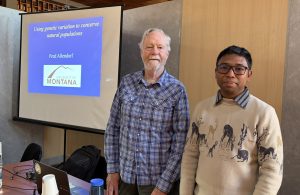
Fred Allendorf is a Regents Professor Emeritus at the University of Montana. He has devoted his career to apply genetics to conservation of biodiversity. More information can be found on his website. Rindra Rakotoarivony is a Lecturer and Researcher in Biological Anthropology and Biodiversity Conservation in the Department of Anthropobiology and Sustainable Development, University of Antananarivo, Madagascar. More information can be found on his LinkedIn profile.
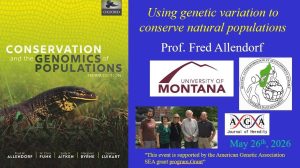
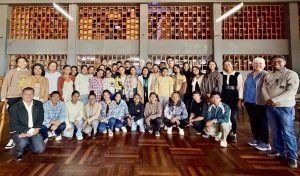
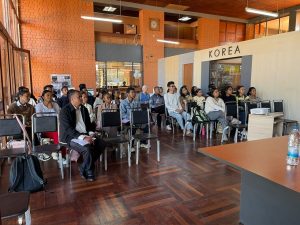
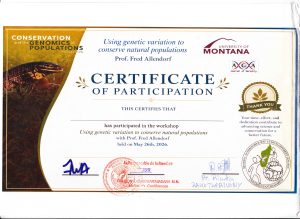
A one-day workshop on using genetics to conserve natural populations was held at the University of Antananarivo, Madagascar on 26 May 2026. The workshop was taught by Fred Allendorf, and his co-authored 2022 book was used as a text. Rindra Rakotoarivony was in charge of facilitating, translating, and explaining technical comments to the students. The workshop was attended by some 40 university students from the Department of Anthropobiology and Sustainable Development.
The workshop focused on five aspects of applying genetics to conservation: chromosomes, genomics, genetic divergence among populations, genetic identification of species, and eDNA. The lectures and discussion focused on examples of species from Madagascar, an incredible hotspot of biodiversity.
For example, Madagascar has about 400 known species of frogs. Genetic studies suggest the true total could approach 600 species because many species lineages found with DNA analysis have not yet been formally described. Madagascar has roughly 50% as many frog species as the entire African continent, despite having only about 2% of the land area.
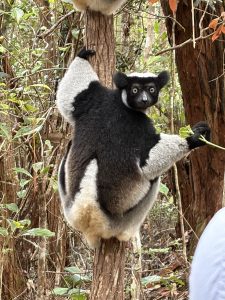
In addition, the indri (Indri indri), the largest lemur species, is critically endangered. Total population estimates are uncertain (1,000-10,000; Gamba et al. 2022). The population is rapidly shrinking and is expected to decrease by 75% over the next 25 years. A recent genomic study of 50 species of lemurs found that indri has high mean nucleotide heterozygosity (Orkin et al. 2025); this suggests that historical population sizes of indri were much higher.
We are currently preparing a paper for the Journal of Heredity that will describe the workshop and discuss applying genetics to the conservation of biodiversity in Madagascar.
References:
Allendorf, F.W., W.C. Funk, S.N. Aitken, M. Byrne, and G. Luikart. 2022. Conservation and the Genomics of Populations, 3rd edition. Oxford University Press.
Gamba, M., V. Torti, J. Powzyk, U. Thalmann, L. Miaretsoa, R. M. Randrianarison, and C. Giacoma. 2022. Indriidae: Indri indri, Indri, Babakoto. S. M. Goodman, ed., The New Natural History of Madagascar, Princeton University Press. Vol. 2, pp. 1967-1971.
Orkin, J.D., L.F.K. Kuderna, N. Hermosilla-Albala, et al. 2025. Ecological and anthropogenic effects on the genomic diversity of lemurs in Madagascar. Nature Ecology and Evolution 9: 42–56.