




Aaron Shafer is an Assistant Professor at Trent University, Canada. Their research uses genomic and bioinformatics tools to characterize adaptive and demographic processes in natural populations. Research organisms in the lab currently include shrews, deer, caribou and mountain goats. Lead-author Aidan Jamieson was an honours biology student who is now doing a MSc at York […]
Category: Blogging
What role do pedigrees play in the preservation of the Galapagos giant tortoise?
About the author: Angie Bradley wrote this post as part of Dr. Stacy Krueger-Hadfield‘s Principles of Scientific Investigation course. Angie is a student in the Accelerated Bachelor’s/Master’s of Biology Program at UAB. In her time at university, Angie has become passionate about genetics, aging, and molecular biology. She hopes to one day attend dental school and […]
Habitat Fragmentation of the Catfish Hemibagrus spilopterus: Dammed If We Do
About the author: Rose Ferguson wrote this post as part of Dr. Stacy Krueger-Hadfield‘s Principles of Scientific Investigation course. She is currently a dual Bachelor’s and Master’s student through the Accelerated Bachelor’s to Master’s program at UAB. She is planning on conducting research in Dr. Dustin Kemp’s lab beginning spring of 2021. With COVID-19 safety […]
Bridge over troubled water: getting across the conservation genetics gap
About the author: Dr Helen Taylor is a conservation geneticist who studied for her PhD in New Zealand, working on inbreeding in little spotted kiwi. She went on to undertake postdoctoral research on inbreeding and male fertility in passerines and, at that point, became interested in the integration of genetics into conservation management. After […]
Parasite Tagging: A Surprising Identification Strategy in Ecological Research
Say you are studying a population of anadromous fish. These fish live in the ocean and swim upriver to spawn, with each fish returning to the river in which it hatched. The different rivers wind up containing separate subpopulations, as fish from different rivers never interbreed. How can these distinct subpopulations be recognized when the […]
Genetic and epigenetic relationships across evolutionary and ecological timescales in Icelandic stickleback
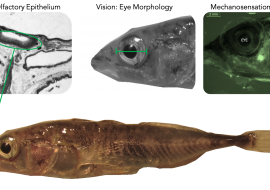
The ability of organisms to colonize or adapt to new and changing environments is of critical interest in biology, especially considering the threats and advances of human-induced environmental change. Certain traits may play a key role in determining population persistence or decline in the face of climate change, habitat fragmentation, and the like. In the […]
Swiss army knife genetics: Does pleiotropy do all the adaptation job in Mimulus guttatus?
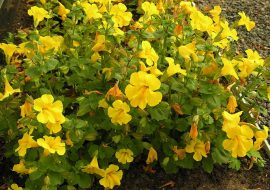
It is not a simple task to adapt to a new environment. An organism needs to acclimate itself to multiple new conditions, from differences in climate to novel parasites and predators awaiting for a newcomer. Such adaptive multitasking might take a long time to form at the genetic level and as a consequence delay the […]
Mind the gap: why is genetics often missing from conservation?
In this series, written specially for the AGA blog, Dr Taylor will be exploring the gap between conservation genetics research and conservation implementation, showcasing some examples of how the gap is being closed for various species and projects, and exploring what it means to be a conservation geneticist in the modern sense (aka, why at […]
It’s all about scale – evolution’s predictability (or lack thereof) across different spatial scales
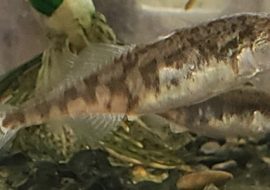
In the late 20thcentury, a popular science communicator named Stephen Jay Gould asked a deceptively simple question: If we turned back the tape of life to the very beginning and allowed it to repeat from the beginning, would we arrive at a similar endpoint? In other words, how predictable and repeatable is evolution, and to […]
An ode to the mudosphere
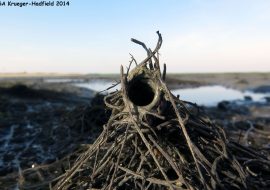
Field work has been cancelled the world over due to COVID-19. Over at The Molecular Ecologist, the contributors curated some photos from our exploits in the field as a nostalgic post to life pre-lockdown (if you have photos, be sure to send them to TMEfieldworkphotos@gmail.com). My lab spends a lot of time in mud – […]