




Aisha O’ Connor wrote this post as part of Dr. Stacy Krueger-Hadfield’s Principles of Scientific Investigation course at the University of Alabama at Birmingham. Aisha is a non-thesis Masters student in the Krueger-Hadfield lab, and is interested in marine conservation and sustainable management of marine resources. Aisha tweets @Aisha_MOC. Imagine swimming 1000’s of […]
Category: Conservation
What role do pedigrees play in the preservation of the Galapagos giant tortoise?
About the author: Angie Bradley wrote this post as part of Dr. Stacy Krueger-Hadfield‘s Principles of Scientific Investigation course. Angie is a student in the Accelerated Bachelor’s/Master’s of Biology Program at UAB. In her time at university, Angie has become passionate about genetics, aging, and molecular biology. She hopes to one day attend dental school and […]
Habitat Fragmentation of the Catfish Hemibagrus spilopterus: Dammed If We Do
About the author: Rose Ferguson wrote this post as part of Dr. Stacy Krueger-Hadfield‘s Principles of Scientific Investigation course. She is currently a dual Bachelor’s and Master’s student through the Accelerated Bachelor’s to Master’s program at UAB. She is planning on conducting research in Dr. Dustin Kemp’s lab beginning spring of 2021. With COVID-19 safety […]
Bridge over troubled water: getting across the conservation genetics gap
About the author: Dr Helen Taylor is a conservation geneticist who studied for her PhD in New Zealand, working on inbreeding in little spotted kiwi. She went on to undertake postdoctoral research on inbreeding and male fertility in passerines and, at that point, became interested in the integration of genetics into conservation management. After […]
Mind the gap: why is genetics often missing from conservation?

In this series, written specially for the AGA blog, Dr Taylor will be exploring the gap between conservation genetics research and conservation implementation, showcasing some examples of how the gap is being closed for various species and projects, and exploring what it means to be a conservation geneticist in the modern sense (aka, why at […]
What if by overestimating the complexity of the genomic basis of a trait, we’re underestimating the complexity of its evolutionary dynamics?
The genomic bases, or architectures, of complex traits are… complex. But what if by overestimating the complexity of some aspects of the genomic architecture of a trait, we’re actually underestimating the complexity of its evolutionary dynamics? This notion struck me when two things clicked while I was preparing a fellowship application back in 2017. First, […]
Is European bison really back?
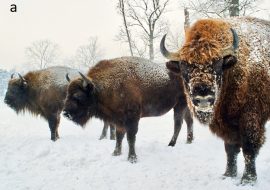
Humans constantly interact with their environment. They modify habitats, transfer species from one place to another, domesticate some species while contributing to the extinction of others. To reverse the process of extinction, we’ve been reintroducing taxa since the 1800s. Reintroduction refers to the action of establishing self-sustaining and healthy populations of extinct or critically endangered […]
Studying the genetics of migration using hybrids from a migratory divide
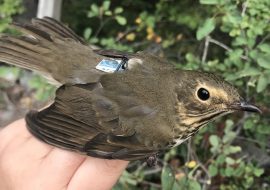
Every spring, nature enthusiasts are excited for another bird migration made evident by the countless posts on social media noting rare warblers spotted in backyards and high species counts on birding trips. And the excitement is warranted, as migration is an amazing feat, both ubiquitous and complex, requiring coordination of numerous adaptations for the birds […]
What happens when hunting history, whale culture, genetics, and an international collaboration work towards a common goal?
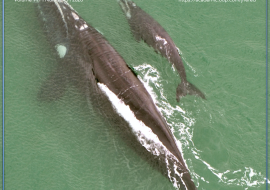
Right whales were given their name because they were the rightwhales to hunt: they swim slowly near the ocean’s surface and make predictable annual migrations to easily accessible bays along the coast. They were hunted to near extinction before international protections were enacted in 1935. As the species recovered, researchers have acquired a myriad of […]
Surviving cyanide – one path or many?
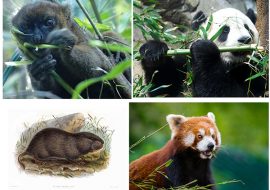
Cyanide is deadly – to most things. In high enough doses it blocks the body’s ability to create energy by interrupting cellular respiration. But even at non-lethal doses it has knock-on effects throughout the body. Despite this, a few mammals eat it regularly. In my last post, I described how I found multiple ways in […]