




About the author: Angie Bradley wrote this post as part of Dr. Stacy Krueger-Hadfield‘s Principles of Scientific Investigation course. Angie is a student in the Accelerated Bachelor’s/Master’s of Biology Program at UAB. In her time at university, Angie has become passionate about genetics, aging, and molecular biology. She hopes to one day attend dental school and […]
Category: Population genetics
Parasite Tagging: A Surprising Identification Strategy in Ecological Research
Say you are studying a population of anadromous fish. These fish live in the ocean and swim upriver to spawn, with each fish returning to the river in which it hatched. The different rivers wind up containing separate subpopulations, as fish from different rivers never interbreed. How can these distinct subpopulations be recognized when the […]
Genetic and epigenetic relationships across evolutionary and ecological timescales in Icelandic stickleback
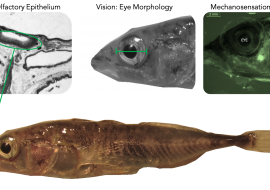
The ability of organisms to colonize or adapt to new and changing environments is of critical interest in biology, especially considering the threats and advances of human-induced environmental change. Certain traits may play a key role in determining population persistence or decline in the face of climate change, habitat fragmentation, and the like. In the […]
Mind the gap: why is genetics often missing from conservation?

In this series, written specially for the AGA blog, Dr Taylor will be exploring the gap between conservation genetics research and conservation implementation, showcasing some examples of how the gap is being closed for various species and projects, and exploring what it means to be a conservation geneticist in the modern sense (aka, why at […]
What if by overestimating the complexity of the genomic basis of a trait, we’re underestimating the complexity of its evolutionary dynamics?
The genomic bases, or architectures, of complex traits are… complex. But what if by overestimating the complexity of some aspects of the genomic architecture of a trait, we’re actually underestimating the complexity of its evolutionary dynamics? This notion struck me when two things clicked while I was preparing a fellowship application back in 2017. First, […]
Is European bison really back?
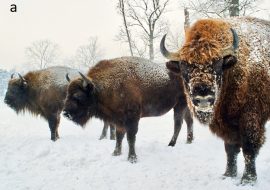
Humans constantly interact with their environment. They modify habitats, transfer species from one place to another, domesticate some species while contributing to the extinction of others. To reverse the process of extinction, we’ve been reintroducing taxa since the 1800s. Reintroduction refers to the action of establishing self-sustaining and healthy populations of extinct or critically endangered […]
To band or not to band: what drives the expression of fashion accessories in female pipefish?
“Tale as old as time. Female chooses male. Male is large in size. Male has weaponry. Unsurprisingly! Male’s ornamentation. Male’s behavior. Female makes the eggs. Takes care of the young. Male and female roles.”1 But not all the time! 1Adapted from Disney’s “Beauty and the Beast” written by Howard Ashman As the female is usually […]
What happens when hunting history, whale culture, genetics, and an international collaboration work towards a common goal?
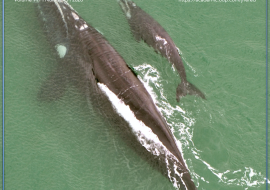
Right whales were given their name because they were the rightwhales to hunt: they swim slowly near the ocean’s surface and make predictable annual migrations to easily accessible bays along the coast. They were hunted to near extinction before international protections were enacted in 1935. As the species recovered, researchers have acquired a myriad of […]
Mountains high … valleys wide … can keep me from getting to you
The Sierra Nevada range towers over the Basin below, cutting the skyline with a jagged edge as far as the eye can see. Mountain ranges, like the Sierra Nevada, are symbolic of western North America and present barriers not only to most day hikers, but to many plants and animal too. For many alpine taxa, […]